Monday, November 28, 2011

When you're burned...

A long time ago my sister told me something she read. I can't find the quote and have no idea where she go it, so this is almost certainly misquoted and unattributed.

"There are two ways to start a story. Either the hero is at the top and the story starts just before he falls, or the story starts 5 minutes after he hits the bottom."

I've always liked that. For roleplaying games, I like the second option better than the first.

Or really any game.


I like it for a number of reasons. For one thing, it gives the game an immediate driving goal. Usually that goal is "don't die". Anything is threatening. The players have nothing and are literally one kobold away from death.

The other day a friend of mine, well three actually, told me about how much fun they were having with Skyrim. Apparently, it starts with the character escaping from execution and then the game lets the player do...whatever they want. But, that's it. Moments after not dying, you have a world to explore.

Right now I am reading the John Carter books. Those books begin before John goes to Barsoom, but really, the story begins when he wakes up, naked, on an alien planet. The Chronicles of Narnia do the same thing. Others take away the hero's memory as well, like in the Bourne Identity or The Long Kiss Goodnight.

There are plenty of ways for characters to start with nothing in the game. I love using the amnesia thing. It's worked so well so many times I want to use it all the time. To date, I don't think I've ever used the "Trapped in Another World" thing. Maybe I should. I've done others, like having the heroes escape prison or whatever right from the bat.

Either way, I am fairly sure that, unless I get otherwise inspired, most of my games will have this conversation during character creation.

Player: "So how much gear can we buy?"
Me: "I wouldn't worry about that."

Thursday, November 24, 2011

Why Savage Worlds is e6 (8, 10, etc)

Last time, I talked about E6. The more I thought about it, the more I realized that the way E6 deals with "high level" is basically the same as Savage Worlds.

That is, once a player in SW gets to Legendary, they just start collecting edges and (slowly) improving traits.

Which is pretty much what E6 does. Just, you know, feats instead of edges. Because naming them different is damn near the only real difference.

There's a feat for that

while E6 and SW came to the same basic strategy, they got there in different ways. SW has some inherent limitations because it relies more on rolling dice than adding modifiers. There are only so many dice, so you have a semi-stable "upper limit".

E6 got there because d20 relies on modifiers and few dice. Thus, there is no true upper limit. As the game progresses, the modifiers get more and more complex until the system just breaks under the strain. E6 bypasses this by creating an upper limit around where the math is still efficient.

Either game is more or less fine, I'm not claiming one is superior. I just think the design strategy is interesting. I don't care for Savage Worlds damage system, and d20 (especially Pathfinder) is rules heavy. Both are flawed, but both are good.


Saturday, October 29, 2011

Sounding Boards

Today I spent the greater part of the day (that I should have been doing work) talking D&D with former student. We talked at length about systems and designs and house rules and gaming groups. All that nerdy stuff. Total waste of the day in terms of productivity.

went kinda like this.
While the former student and I diverged on numerous points, we had a great deal in common as well and shared our knowledge bases well.

He reminded me of this thing called "E6" which basically caps the level progression of D&D at level 6. After that you get some feats that can raise your power level a bit but not much. The concept is to take advantage of the "sweet spot" of D&D somewhere around level 5 to 10...before the bookkeeping gets out of hand and the characters become super heroes.

On the surface I like it in concept. I still hate certain aspects of the base rules (attacks of opportunity) and find feats to be conceptually sound but flawed.

Still, from a GM who likes more gritty games with low magic, this is tempting.

For example, I've already got the rules revision I like done. Within the framework of and E6 game (although, with a Pathfinder core I think E10 would be reasonable) I could be satisfied. Most of the stuff I dread will be off the table and the rules remain more or less streamlined.

Most of the arguments I have against this sort of power cap break down the minute I ask myself how many times I've ever run a game over level 10? The answer is few. Then, I ask how much I actually enjoyed the game after level 10? The answer is fewer...maybe none.

So, maybe it's not such a bad idea.

Monday, October 24, 2011

The Maelstrom

I'm changing the name of the "Pathfinder Lite" project to the "Maelstrom" project.
In the olden days people commonly made some house rules for any given campaign. Often people said "Hey, we're playing Gary's Greyhawk Campaign" or Jim's "Dwimmermount Campaign" rather than saying "We're playing D&D".

Nothing wrong with either, but there were certain assumptions in each. I am moving Maelstrom toward that sort of thinking. For the Maelstrom campaign, it's a rules lite version of 3rd edition. I'm not even drawing an association toward Pathfinder anymore since most of the bones come from either the SRD or blatant theft from 4e (which really, the bones of which are in 3e so it's only sorta blatant.

A few things I will tell you about the new rules, a "What to expect" for what's coming. First of all, the entire Combat chapter is 9 pages long. Compare that to Pathfinder's 28 pages (with itty bitty font) or 4e's 32 pages (with reasonable font).

What's new?
There are 3 action types (Standard, move, and free). FYI Pathfinder had 8 types (including one called "Not an Action").
No Critical confirmation, you roll a 20, you get a crit. Simple as that.
I will use a whopping 16 combat conditions. (down from the SRD's 38 and Pathfinder's list of 34).
I'm going to use 4e's Combat Advantage...because I like it better than "flat-footed".
Cover and Concealment are simplified. Rather than pages of deciding how much cover, the GM just decides and offers a +4 to +8 bonus.
Attack of Opportunity are gone. They are goofy and annoying.
Most of the Special Actions (aid another, bull rush, charge, grapple, etc) have been stripped down to a simpler mechanic.
Natural healing uses the short/extended rest mechanic (or variation thereof) from 4e. I never liked the 3e natural healing.
There is no Dying, recovery, stable, etc mechanic. At 0 hit points, you die. Pure and simple.


Sunday, October 23, 2011

Sandbox: The Map, part 3

I've been busy working on the campaign setting rules (which, at the moment is a twisted combination of several incarnations of D&D). But, I've also got the bones of the "world" map done. I took this:


and turned the parts into this:


I really like the spiral image of the island chains, it immediately makes me wonder what hell is at the center. If anyone is interested, the South-central island chain is Sheol. It is has the highest density of island and the greatest number of island. It's packed. In some cases, there is less than 5 miles from one island to another. I imagine the currents are insane and treacherous.

Other good news, based on the design of the map I have a name for the campaign.

The Maelstrom.

The only major change I am considering is moving the 3 wild island on the corners into one corner. Part of me really likes having them broken up and scattered to the corners...and the mystery of why there is not one in the other corner...and why they are not part of the spiral.

But, aesthetically, maybe they would be better clumped in one corner. For now, they remain in the corners.

Saturday, October 1, 2011

Pathfinder Lite: Barbarian

When most people think about why they want to play a barbarian, most will tell you barbarians are cool because they rage. Rage allows them to do more damage and take more damage for a short while. Some will mention their big ol' d12 hit dice or the Damage Reduction, but those features are along the same lines as rage.
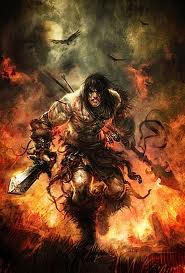
Basically, they picture this.
You know what they do not think about?
Trap Sense.
(and to a lesser degree, uncanny dodge).

Seriously, why is this a barbarian class ability? At best it should be an optional feature among the list of Pathfinder rage powers.
Pictured: a total lack of trap sensing.
It's not that the feature is unbalanced or anything, it's just totally misplaced. As a Rogue or Bard ability, it makes perfect sense. But a barbarian? I just don't see it, nor will I continue to keep it as part of the barbarian design.

Up till now, I've ignored the uncanny dodge thing. But I wanna attack the whole concept of using feats as class features. Yes, it's central to the fighter. The whole point of the fighter is feats. I get that. But, if one the main features of a class is a feat...I don't know it just takes away from the uniqueness of the class. So I want to avoid that sort of nonsense as much as possible.
Careful, or they will dodge you...uncannily
Finally, I want to address something I looooooooove about the Pathfinder barbarian but need to get rid of. The rage powers aspect of the class introduced in Pathfinder is awesome...but to reduce the complexity of the game I want to get rid of that sort of thing. I want class features to be pretty well set. I don't want character creation bogged down by a new choice every few levels. You select a class and that's what you get, simple and set.

But, since I love them so much and removing basically everything except Rage and Damage reduction is not the goal, I decide to replace the trap sense and uncanny dodge with rage powers and fill in the rest of the class with the simplest and most straightforward rage powers. What I end up with is the following:

Barbarian
    Barbarians excel in combat, possessing the martial prowess and fortitude to take on foes seemingly far superior to themselves. With rage granting them boldness and daring beyond that of most other warriors, barbarians charge furiously into battle and ruin all who would stand in their way.
Hit Die: d12
Skills: Choose training in either Physical or Survival.
Weapon Proficiency: Simple & Martial
Armor Proficiency: Light, Medium, and Light Shield
Features:
    Fast Movement: A barbarian’s speed is faster than the norm for her race by +10 feet.
    Rage: A Barbarian can rage for a number of rounds per day equal to 4 + his or her normal Constitution modifier. At each level after 1st, he or she can rage for 2 additional rounds. Entering rage is a free action. An extended rest renews the number of rounds a barbarian can rage.
    While in rage a barbarian gains: +4 to Strength and Constitution, +2 to Will saves, -2 Armor Class, and +2 Hit Points per level (which are used last and disappear when the rage ends).
    When the rage ends, the barbarian is fatigued and suffers -2 to Strength and Dexterity until he or she takes an extended rest. If the barbarian does anything that would further fatigue him or her, she is exhausted and suffers -6 to Strength and Dexterity until he or she takes and extended rest.
    Animal Fury: While in rage, the barbarian gains a bite attack. The bite attack is made at the barbarian’s base attack bonus -5. The bite deals 1d4+Str damage for medium sized barbarians (1d3 for small barbarians).
    Powerful Blow: While in rage, once per encounter, a barbarian gains a +1 to a single damage roll. This bonus increases by +1 at levels 6, 9, 12, 15, and 18.
    Renewed Vigor: While in rage, once per day, the barbarian heals 1d8 + Constitution modifier hit points. For every 4 levels the barbarians healing increases by 1d8 (to a maximum of 5d8 at level 20).
    Raging Physique: While in rage, the barbarian adds his or her level to all Physical skill rolls.
    Swift Foot: While in rage, the barbarians speed increases by +5 feet. This increases to +10 feet at level 10 and +15 feet at level 18.
    Damage Reduction: At 7th level, a barbarian gains damage reduction. This reduces the damage the barbarian takes from each attack. At 10th level, and every three barbarian levels thereafter, this damage reduction rises by 1 point.
    Raging Damage Reduction: While in rage, the barbarian’s damage reduction increases by +1/--. At level 14 this increases to +2/--. At level 20 this increases to +3/--.
    Greater Rage: At 11th level, when a barbarian enters rage, the bonus to his or her Strength and Constitution increases to +6 and +3 to Will saves.
    Fearless Rage: While in rage, a barbarian is immune to fear effects.
    Indomitable Will: While in rage, a barbarian gains +4 on Will saves.
    Mighty Swing: While in rage, the barbarian does maximum damage on a critical hit.
    Tireless Rage: Starting at 17th level, a barbarian no longer becomes fatigued at the end of his or her rage.
    Mighty Rage: At 20th level, when a barbarian enters rage, the bonus to his or her Strength and Constitution increases to +8 and +4 to Will saves. 


like a boss.

Pathfinder Lite

I am working on two gaming projects right now that kinda go hand-in-hand.

The first is a sandbox (which I've finally named "Maelstrom"). The second is a revision/reduction of the 3.x D&D rules. At it's core is Pathfinder, which I feel to be the best (rules as written) version of the 3rd edition.

The only issues I have with it are it's enormous bulk. Not just the physical size of the text (575 pages) but also the cumbersome rules inherent to 3rd edition. Microlite kinda proves that 3e need not be so bulky and I'd like to trim pathfinder down.

I'd like a rule set that new, inexperienced players can enjoy and more seasoned players can respect. Not Iron Heroes, but nothing so drastic as Microlite.

I know I will be getting rid of things like the 3 kinds of Armor Class (flat-footed, normal, touch), attacks of opportunity (more trouble than they are worth), and other unnecessary complexities. I want to bring in some of the standardizations of 4e where I can. For example, the burst and blast mechanics of 4e.

Pathfinder Lite

Ability Scores
Barbarian
Bard
Cleric
Druid
Fighter
Monk
Paladin
Ranger
Rogue
Sorcerer
Wizard
Spellcasting