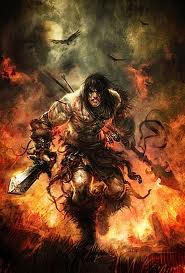
I'm changing the name of the "Pathfinder Lite" project to the "Maelstrom" project.
In the olden days people commonly made some house rules for any given campaign. Often people said "Hey, we're playing Gary's Greyhawk Campaign" or Jim's "Dwimmermount Campaign" rather than saying "We're playing D&D".
Nothing wrong with either, but there were certain assumptions in each. I am moving Maelstrom toward that sort of thinking. For the Maelstrom campaign, it's a rules lite version of 3rd edition. I'm not even drawing an association toward Pathfinder anymore since most of the bones come from either the SRD or blatant theft from 4e (which really, the bones of which are in 3e so it's only sorta blatant.
A few things I will tell you about the new rules, a "What to expect" for what's coming. First of all, the entire Combat chapter is 9 pages long. Compare that to Pathfinder's 28 pages (with itty bitty font) or 4e's 32 pages (with reasonable font).
What's new?
There are 3 action types (Standard, move, and free). FYI Pathfinder had 8 types (including one called "Not an Action").
No Critical confirmation, you roll a 20, you get a crit. Simple as that.
I will use a whopping 16 combat conditions. (down from the SRD's 38 and Pathfinder's list of 34).
I'm going to use 4e's Combat Advantage...because I like it better than "flat-footed".
Cover and Concealment are simplified. Rather than pages of deciding how much cover, the GM just decides and offers a +4 to +8 bonus.
Attack of Opportunity are gone. They are goofy and annoying.
Most of the Special Actions (aid another, bull rush, charge, grapple, etc) have been stripped down to a simpler mechanic.
Natural healing uses the short/extended rest mechanic (or variation thereof) from 4e. I never liked the 3e natural healing.
There is no Dying, recovery, stable, etc mechanic. At 0 hit points, you die. Pure and simple.
Monday, October 24, 2011
Sunday, October 23, 2011
Sandbox: The Map, part 3
I've been busy working on the campaign setting rules (which, at the moment is a twisted combination of several incarnations of D&D). But, I've also got the bones of the "world" map done. I took this:
and turned the parts into this:
I really like the spiral image of the island chains, it immediately makes me wonder what hell is at the center. If anyone is interested, the South-central island chain is Sheol. It is has the highest density of island and the greatest number of island. It's packed. In some cases, there is less than 5 miles from one island to another. I imagine the currents are insane and treacherous.
Other good news, based on the design of the map I have a name for the campaign.
The Maelstrom.
The only major change I am considering is moving the 3 wild island on the corners into one corner. Part of me really likes having them broken up and scattered to the corners...and the mystery of why there is not one in the other corner...and why they are not part of the spiral.
But, aesthetically, maybe they would be better clumped in one corner. For now, they remain in the corners.
and turned the parts into this:
I really like the spiral image of the island chains, it immediately makes me wonder what hell is at the center. If anyone is interested, the South-central island chain is Sheol. It is has the highest density of island and the greatest number of island. It's packed. In some cases, there is less than 5 miles from one island to another. I imagine the currents are insane and treacherous.
Other good news, based on the design of the map I have a name for the campaign.
The Maelstrom.
The only major change I am considering is moving the 3 wild island on the corners into one corner. Part of me really likes having them broken up and scattered to the corners...and the mystery of why there is not one in the other corner...and why they are not part of the spiral.
But, aesthetically, maybe they would be better clumped in one corner. For now, they remain in the corners.
Saturday, October 1, 2011
Pathfinder Lite: Barbarian
When most people think about why they want to play a barbarian, most will tell you barbarians are cool because they rage. Rage allows them to do more damage and take more damage for a short while. Some will mention their big ol' d12 hit dice or the Damage Reduction, but those features are along the same lines as rage.
You know what they do not think about?
Trap Sense.
(and to a lesser degree, uncanny dodge).
Seriously, why is this a barbarian class ability? At best it should be an optional feature among the list of Pathfinder rage powers.
It's not that the feature is unbalanced or anything, it's just totally misplaced. As a Rogue or Bard ability, it makes perfect sense. But a barbarian? I just don't see it, nor will I continue to keep it as part of the barbarian design.
Up till now, I've ignored the uncanny dodge thing. But I wanna attack the whole concept of using feats as class features. Yes, it's central to the fighter. The whole point of the fighter is feats. I get that. But, if one the main features of a class is a feat...I don't know it just takes away from the uniqueness of the class. So I want to avoid that sort of nonsense as much as possible.
Finally, I want to address something I looooooooove about the Pathfinder barbarian but need to get rid of. The rage powers aspect of the class introduced in Pathfinder is awesome...but to reduce the complexity of the game I want to get rid of that sort of thing. I want class features to be pretty well set. I don't want character creation bogged down by a new choice every few levels. You select a class and that's what you get, simple and set.
But, since I love them so much and removing basically everything except Rage and Damage reduction is not the goal, I decide to replace the trap sense and uncanny dodge with rage powers and fill in the rest of the class with the simplest and most straightforward rage powers. What I end up with is the following:
Barbarian
Barbarians excel in combat, possessing the martial prowess and fortitude to take on foes seemingly far superior to themselves. With rage granting them boldness and daring beyond that of most other warriors, barbarians charge furiously into battle and ruin all who would stand in their way.
Hit Die: d12
Skills: Choose training in either Physical or Survival.
Weapon Proficiency: Simple & Martial
Armor Proficiency: Light, Medium, and Light Shield
Features:
Fast Movement: A barbarian’s speed is faster than the norm for her race by +10 feet.
Rage: A Barbarian can rage for a number of rounds per day equal to 4 + his or her normal Constitution modifier. At each level after 1st, he or she can rage for 2 additional rounds. Entering rage is a free action. An extended rest renews the number of rounds a barbarian can rage.
While in rage a barbarian gains: +4 to Strength and Constitution, +2 to Will saves, -2 Armor Class, and +2 Hit Points per level (which are used last and disappear when the rage ends).
When the rage ends, the barbarian is fatigued and suffers -2 to Strength and Dexterity until he or she takes an extended rest. If the barbarian does anything that would further fatigue him or her, she is exhausted and suffers -6 to Strength and Dexterity until he or she takes and extended rest.
Animal Fury: While in rage, the barbarian gains a bite attack. The bite attack is made at the barbarian’s base attack bonus -5. The bite deals 1d4+Str damage for medium sized barbarians (1d3 for small barbarians).
Powerful Blow: While in rage, once per encounter, a barbarian gains a +1 to a single damage roll. This bonus increases by +1 at levels 6, 9, 12, 15, and 18.
Renewed Vigor: While in rage, once per day, the barbarian heals 1d8 + Constitution modifier hit points. For every 4 levels the barbarians healing increases by 1d8 (to a maximum of 5d8 at level 20).
Raging Physique: While in rage, the barbarian adds his or her level to all Physical skill rolls.
Swift Foot: While in rage, the barbarians speed increases by +5 feet. This increases to +10 feet at level 10 and +15 feet at level 18.
Damage Reduction: At 7th level, a barbarian gains damage reduction. This reduces the damage the barbarian takes from each attack. At 10th level, and every three barbarian levels thereafter, this damage reduction rises by 1 point.
Raging Damage Reduction: While in rage, the barbarian’s damage reduction increases by +1/--. At level 14 this increases to +2/--. At level 20 this increases to +3/--.
Greater Rage: At 11th level, when a barbarian enters rage, the bonus to his or her Strength and Constitution increases to +6 and +3 to Will saves.
Fearless Rage: While in rage, a barbarian is immune to fear effects.
Indomitable Will: While in rage, a barbarian gains +4 on Will saves.
Mighty Swing: While in rage, the barbarian does maximum damage on a critical hit.
Tireless Rage: Starting at 17th level, a barbarian no longer becomes fatigued at the end of his or her rage.
Mighty Rage: At 20th level, when a barbarian enters rage, the bonus to his or her Strength and Constitution increases to +8 and +4 to Will saves.
![]() |
| Basically, they picture this. |
Trap Sense.
(and to a lesser degree, uncanny dodge).
Seriously, why is this a barbarian class ability? At best it should be an optional feature among the list of Pathfinder rage powers.
![]() |
| Pictured: a total lack of trap sensing. |
Up till now, I've ignored the uncanny dodge thing. But I wanna attack the whole concept of using feats as class features. Yes, it's central to the fighter. The whole point of the fighter is feats. I get that. But, if one the main features of a class is a feat...I don't know it just takes away from the uniqueness of the class. So I want to avoid that sort of nonsense as much as possible.
![]() |
| Careful, or they will dodge you...uncannily |
But, since I love them so much and removing basically everything except Rage and Damage reduction is not the goal, I decide to replace the trap sense and uncanny dodge with rage powers and fill in the rest of the class with the simplest and most straightforward rage powers. What I end up with is the following:
Barbarian
Barbarians excel in combat, possessing the martial prowess and fortitude to take on foes seemingly far superior to themselves. With rage granting them boldness and daring beyond that of most other warriors, barbarians charge furiously into battle and ruin all who would stand in their way.
Hit Die: d12
Skills: Choose training in either Physical or Survival.
Weapon Proficiency: Simple & Martial
Armor Proficiency: Light, Medium, and Light Shield
Features:
Fast Movement: A barbarian’s speed is faster than the norm for her race by +10 feet.
Rage: A Barbarian can rage for a number of rounds per day equal to 4 + his or her normal Constitution modifier. At each level after 1st, he or she can rage for 2 additional rounds. Entering rage is a free action. An extended rest renews the number of rounds a barbarian can rage.
While in rage a barbarian gains: +4 to Strength and Constitution, +2 to Will saves, -2 Armor Class, and +2 Hit Points per level (which are used last and disappear when the rage ends).
When the rage ends, the barbarian is fatigued and suffers -2 to Strength and Dexterity until he or she takes an extended rest. If the barbarian does anything that would further fatigue him or her, she is exhausted and suffers -6 to Strength and Dexterity until he or she takes and extended rest.
Animal Fury: While in rage, the barbarian gains a bite attack. The bite attack is made at the barbarian’s base attack bonus -5. The bite deals 1d4+Str damage for medium sized barbarians (1d3 for small barbarians).
Powerful Blow: While in rage, once per encounter, a barbarian gains a +1 to a single damage roll. This bonus increases by +1 at levels 6, 9, 12, 15, and 18.
Renewed Vigor: While in rage, once per day, the barbarian heals 1d8 + Constitution modifier hit points. For every 4 levels the barbarians healing increases by 1d8 (to a maximum of 5d8 at level 20).
Raging Physique: While in rage, the barbarian adds his or her level to all Physical skill rolls.
Swift Foot: While in rage, the barbarians speed increases by +5 feet. This increases to +10 feet at level 10 and +15 feet at level 18.
Damage Reduction: At 7th level, a barbarian gains damage reduction. This reduces the damage the barbarian takes from each attack. At 10th level, and every three barbarian levels thereafter, this damage reduction rises by 1 point.
Raging Damage Reduction: While in rage, the barbarian’s damage reduction increases by +1/--. At level 14 this increases to +2/--. At level 20 this increases to +3/--.
Greater Rage: At 11th level, when a barbarian enters rage, the bonus to his or her Strength and Constitution increases to +6 and +3 to Will saves.
Fearless Rage: While in rage, a barbarian is immune to fear effects.
Indomitable Will: While in rage, a barbarian gains +4 on Will saves.
Mighty Swing: While in rage, the barbarian does maximum damage on a critical hit.
Tireless Rage: Starting at 17th level, a barbarian no longer becomes fatigued at the end of his or her rage.
Mighty Rage: At 20th level, when a barbarian enters rage, the bonus to his or her Strength and Constitution increases to +8 and +4 to Will saves.
![]() |
| like a boss. |
Pathfinder Lite
I am working on two gaming projects right now that kinda go hand-in-hand.
The first is a sandbox (which I've finally named "Maelstrom"). The second is a revision/reduction of the 3.x D&D rules. At it's core is Pathfinder, which I feel to be the best (rules as written) version of the 3rd edition.
The only issues I have with it are it's enormous bulk. Not just the physical size of the text (575 pages) but also the cumbersome rules inherent to 3rd edition. Microlite kinda proves that 3e need not be so bulky and I'd like to trim pathfinder down.
I'd like a rule set that new, inexperienced players can enjoy and more seasoned players can respect. Not Iron Heroes, but nothing so drastic as Microlite.
I know I will be getting rid of things like the 3 kinds of Armor Class (flat-footed, normal, touch), attacks of opportunity (more trouble than they are worth), and other unnecessary complexities. I want to bring in some of the standardizations of 4e where I can. For example, the burst and blast mechanics of 4e.
Pathfinder Lite
Ability Scores
Barbarian
Bard
Cleric
Druid
Fighter
Monk
Paladin
Ranger
Rogue
Sorcerer
Wizard
Spellcasting
The first is a sandbox (which I've finally named "Maelstrom"). The second is a revision/reduction of the 3.x D&D rules. At it's core is Pathfinder, which I feel to be the best (rules as written) version of the 3rd edition.
The only issues I have with it are it's enormous bulk. Not just the physical size of the text (575 pages) but also the cumbersome rules inherent to 3rd edition. Microlite kinda proves that 3e need not be so bulky and I'd like to trim pathfinder down.
I'd like a rule set that new, inexperienced players can enjoy and more seasoned players can respect. Not Iron Heroes, but nothing so drastic as Microlite.
I know I will be getting rid of things like the 3 kinds of Armor Class (flat-footed, normal, touch), attacks of opportunity (more trouble than they are worth), and other unnecessary complexities. I want to bring in some of the standardizations of 4e where I can. For example, the burst and blast mechanics of 4e.
Pathfinder Lite
Ability Scores
Barbarian
Bard
Cleric
Druid
Fighter
Monk
Paladin
Ranger
Rogue
Sorcerer
Wizard
Spellcasting
Friday, September 9, 2011
Dreaming it up
What I want from an RPG is the following:
1. SIMPLE character creation.
2. Interesting character advancement and customization.
3. Clear cut rules and simple encounter design.
4. Quick and lethal, but not too lethal, combat.
5. Easy system customization, modification, and expansion...mostly expansion.
When I started writing this I knew I wanted things, but I figured the list would be longer. Then I wrote it down I was shocked that this was all I thought of.
I'm kinda disappointed with myself.
1. SIMPLE character creation.
2. Interesting character advancement and customization.
3. Clear cut rules and simple encounter design.
4. Quick and lethal, but not too lethal, combat.
5. Easy system customization, modification, and expansion...mostly expansion.
When I started writing this I knew I wanted things, but I figured the list would be longer. Then I wrote it down I was shocked that this was all I thought of.
I'm kinda disappointed with myself.
Sunday, September 4, 2011
Player Records
I love d20.
I love the "old school revolution".
I love d6.
I love Savage Worlds.
I don't really believe 'system' has anything to do with fun at the table. Well, not as much as some people believe it does anyway.
I've bemoaned the parts of RPGs that I don't like. I hate feats, I hate goofy system mechanics, I hate easily broken mechanics, I hate confusing subsystems. But, I've noticed something about my problems with systems.
The parts that erk me and cause problems at the table come in 2 flavors.
The first is badly designed mechanics. (3.0 grappling is the go-to example) That's usually an easy house-rule fix.
The second is character creation. This is the big one that I find commonly problematic in most systems.
d20 is a particularly bad offender. My belief is that character creation should take a 1st time player no more than say, 15 minutes to be up and ready to go with at least a marginal idea of what they can do well.
Now, that's not just me being lazy. I have several good reasons to want (very) easy character creation.
1. Character Creation needs to be fun, but quick because it rarely stays fun very long.
3e character creation is just too complex. If you don't do a few things right, right from the start, and plan things out well, you will not be getting into that prestige class later on. (we'll talk about advancement in a minute). 4e character creation is just...it's just horrid. It's everything 3e was but with more searching through pages and pages of unrelenting crap for that one good power. God forbid having to learn the dozens of powers.
2. If character creation is not fun, or takes a long time, the death (or even injury) of the character in-game is hard to swallow.
You ask the player to put time and energy into a character. Then, you kill them.
I'm not saying a GM should not kill and maim characters. Quite the contrary. The problem is that the investment to make the character is so high that losing the character is a hard pill to swallow and some players have a hard time dealing with that. If the GM decides to not kill characters (or allow them to die) then the player may lose interest in the same way that 'god mode' is only fun for a while.
3. The more complex character creation is, the more complex character advancement is.
This means that every few sessions, you get the joy of redoing the same kind of stuff you did during character creation. While gaining new powers is cool, if you gain too much from too many sources (race, class, level, prestige class, etc.) then it gets to be a lot of bookkeeping.
I could go on, but my point is that the player's end of the rules (especially character creation) needs to be relatively simple. 4e did a great job of making the GMs job easy, but made the player's side of things a bit nightmarish.
My goal in the future is to make sure whatever system I use requires very little in the way of character creation. I want the bookkeeping and such to me almost invisible and automatic. Not without options, but a careful balance between options and over-complication.
I love the "old school revolution".
I love d6.
I love Savage Worlds.
I don't really believe 'system' has anything to do with fun at the table. Well, not as much as some people believe it does anyway.
I've bemoaned the parts of RPGs that I don't like. I hate feats, I hate goofy system mechanics, I hate easily broken mechanics, I hate confusing subsystems. But, I've noticed something about my problems with systems.
The parts that erk me and cause problems at the table come in 2 flavors.
The first is badly designed mechanics. (3.0 grappling is the go-to example) That's usually an easy house-rule fix.
The second is character creation. This is the big one that I find commonly problematic in most systems.
d20 is a particularly bad offender. My belief is that character creation should take a 1st time player no more than say, 15 minutes to be up and ready to go with at least a marginal idea of what they can do well.
![]() |
| if only it was this easy |
1. Character Creation needs to be fun, but quick because it rarely stays fun very long.
3e character creation is just too complex. If you don't do a few things right, right from the start, and plan things out well, you will not be getting into that prestige class later on. (we'll talk about advancement in a minute). 4e character creation is just...it's just horrid. It's everything 3e was but with more searching through pages and pages of unrelenting crap for that one good power. God forbid having to learn the dozens of powers.
![]() |
| Elf paladin. |
You ask the player to put time and energy into a character. Then, you kill them.
![]() |
| why did I play a bard!? |
3. The more complex character creation is, the more complex character advancement is.
This means that every few sessions, you get the joy of redoing the same kind of stuff you did during character creation. While gaining new powers is cool, if you gain too much from too many sources (race, class, level, prestige class, etc.) then it gets to be a lot of bookkeeping.
![]() |
| Thanks to the interaction of my character's race, class, and feat selection, my taxes will rock this year. |
My goal in the future is to make sure whatever system I use requires very little in the way of character creation. I want the bookkeeping and such to me almost invisible and automatic. Not without options, but a careful balance between options and over-complication.
Thursday, September 1, 2011
Sandbox: The Map, part 2
So I was working on the Map some more. I've come to a few specific decisions.
1. I don't want the islands to be too big. Each hex is about 5 miles or so. Irony games wanted them to be much larger so that each island was about the size of the British isles. That's too big for my needs. I'm good with many, small, islands.
2. Rather than the rigid 10 x10 grid, I am going to arrange them a little more chaotically. This is more aesthetically pleasing, but, that's not the main reason. The main reason is because I love world maps more than I thought. Originally, I figured this huge archipelago was in the middle of some sea and there was a main land somewhere. But, as if my mind simply rejected such a notion, a thought burst to my mind in a spray of flowers and sunshine. "What if these islands are the only land masses on the entire planet."
3. Doing a world map in Hexographer is doable, but not easy. Nor is arranging the islands from the one picture I have. I can do it, but I think I need to move it into fractal mapper to make it work. Making larger, hexographer based island maps (as opposed to maps of island chains or the world map) will be better. So in the end I want one ("pretty") world map, seven ("pretty") chain maps, and 100 or so maps of the individual islands. For now, I will focus on the world map, and then chain and island maps as they become necessary.
4. I'm going arrange the island into 7 chains plus another "group" of islands known (for now) as the "wild islands". The chains are geographic, not political, and have names familiar to people I've played with before. They are Aesir (northern), Eden (east-central), Mageddon (western), Nod (eastern), Sheol (south-central), Shinto (southern), and Zion (west-central). The wild islands are scattered all over the place. This arrangement puts Aesir, Nod, Shinto, and Mageddon in the cardinal directions and Sheol, Eden, and Zion in the middle.
5. The original Irony maps are already pre-set up with 3 nations per map. Quick math will tell you that means right at 303 nations. I may not need that many, some 'nations' may exist on more than one map, but I like the pre-set borders. Especially because several of them have 'contested' areas. In other words, areas where active wars are taking place. I need to have an easy framework to build nations, and I think I do, but more on that in another post. I am going to ignore the names of cities and towns from the original Irony maps. The maps were good, but the random name generator was horrid.
1. I don't want the islands to be too big. Each hex is about 5 miles or so. Irony games wanted them to be much larger so that each island was about the size of the British isles. That's too big for my needs. I'm good with many, small, islands.
2. Rather than the rigid 10 x10 grid, I am going to arrange them a little more chaotically. This is more aesthetically pleasing, but, that's not the main reason. The main reason is because I love world maps more than I thought. Originally, I figured this huge archipelago was in the middle of some sea and there was a main land somewhere. But, as if my mind simply rejected such a notion, a thought burst to my mind in a spray of flowers and sunshine. "What if these islands are the only land masses on the entire planet."
![]() |
| Do. Not. Compare. |
4. I'm going arrange the island into 7 chains plus another "group" of islands known (for now) as the "wild islands". The chains are geographic, not political, and have names familiar to people I've played with before. They are Aesir (northern), Eden (east-central), Mageddon (western), Nod (eastern), Sheol (south-central), Shinto (southern), and Zion (west-central). The wild islands are scattered all over the place. This arrangement puts Aesir, Nod, Shinto, and Mageddon in the cardinal directions and Sheol, Eden, and Zion in the middle.
5. The original Irony maps are already pre-set up with 3 nations per map. Quick math will tell you that means right at 303 nations. I may not need that many, some 'nations' may exist on more than one map, but I like the pre-set borders. Especially because several of them have 'contested' areas. In other words, areas where active wars are taking place. I need to have an easy framework to build nations, and I think I do, but more on that in another post. I am going to ignore the names of cities and towns from the original Irony maps. The maps were good, but the random name generator was horrid.
Subscribe to:
Posts (Atom)